

Ryan Bradley | December 12, 2025 | Car Accident \ Missouri Law
Key Takeaways:
- Act within 30 days to retain video footage. RTCC cameras typically hold footage for only 30 days unless it becomes evidence. And businesses may overwrite security footage even faster.
- Not all cameras record videos. MoDOT traffic cameras on highways provide live feeds only. Focus on sources that capture and retain video, like RTCC fixed cameras, Metro Transit systems, and private business security cameras.
- Each agency requires different steps for obtaining video recordings. Public agencies like SLMPD and Metro Transit follow Missouri Sunshine Law request procedures, while private businesses typically need preservation letters (and may require subpoenas).
Video evidence after a crash in St. Louis can be essential for your insurance claim. Recordings can show exactly what happened, such as who ran a red light or whether a driver was texting. Unfortunately, most videos disappear fast. Some agencies only keep recordings for 30 days, and others don’t record at all despite having cameras on every highway.
When you’ve been involved in an accident where fault is disputed, or you are blamed for the crash, you’ll need to know how to request video evidence before it’s gone forever. The footage can prove that another was responsible and make or break your compensation claim.
This guide walks you through the main video sources in St. Louis and shows you how to obtain the footage that proves your case.
Why Video Matters in Missouri Crash Claims
Video footage is prime evidence, because it shows the collision as it happened. For example, a dashcam can catch a driver speeding or changing lanes unsafely, and body camera footage shows the road conditions when the crash happened.
This makes video recordings crucial for your case. Since Missouri uses pure comparative fault, your compensation drops by whatever percentage you’re found at fault. Video can prove someone else is responsible for the crash and help you collect the compensation you truly deserve.
Here are some common video sources to consider:
- Dashcams
- Police body-worn and in-car cameras
- Real Time Crime Center (RTCC) cameras
- Business security systems
- Metro Transit cameras
Missouri’s Sunshine Law lets you request video from government agencies. But active investigations can slow this down. And private businesses aren’t covered by the same laws as public agencies, so you’ll need to ask them directly or get a lawyer to request the footage.
What’s Recorded in St. Louis and for How Long
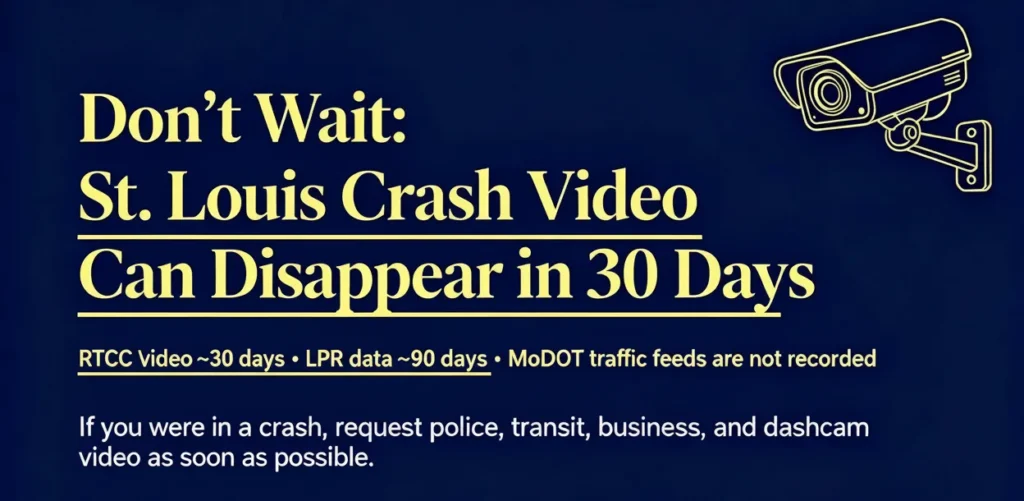
Not every camera you see is actually recording. For example, MoDOT traffic cameras on highways provide live feeds only and don’t record or store footage. That means if your crash happened on I-70, I-44, or I-64, those overhead cameras didn’t capture anything.
The St. Louis Metropolitan Police Department (SLMPD) operates the RTCC with fixed cameras that record and retain footage for 30 days unless the video becomes evidence. The RTCC also monitors live feeds from third-party cameras, but SLMPD doesn’t record these feeds.
Automated license plate readers (ALPRs) typically store data for 90 days. Metro Transit cameras on MetroLink trains, MetroBus vehicles, and at transit facilities record continuously. However, retention of the footage can vary and depend on Metro Transit Police Department policy. Police body-worn and in-car video footage is kept depending on how the footage is classified under Missouri’s law enforcement records retention schedule.
EDR and Vehicle Data You Can Use
Modern vehicles contain an Event Data Recorder (EDR), also often called a “black box,” that captures what happens in the seconds before and during a crash. The EDR records specific data standardized under federal regulations at 49 CFR Part 563, including:
- Vehicle speed
- Throttle position
- Brake application
- Steering input
- Seatbelt status
- Airbag deployment timing
- Delta-V (the change in velocity during impact)
This data can help reconstruct what happened and what caused the crash. For example, it shows if a driver was speeding and whether they hit the brakes before impact. It can also show how severe the collision forces were.
Access to EDR data involves federal regulations and state law regarding property and privacy, such as the federal Driver Privacy Act of 2015. Vehicle owners or lessees control the access to their EDR data and can authorize its download. If you want to get EDR data from the other driver, you either need their consent or you’ll have to issue a subpoena. An attorney can handle the preservation of EDR data from all vehicles in your crash.
How to Request Video from Agencies and Businesses
Each type of video source has its own request process and timeline. But it’s best to act quickly, since many retention windows close within 30 days of your crash. Read our full guide on Missouri dashcam laws.
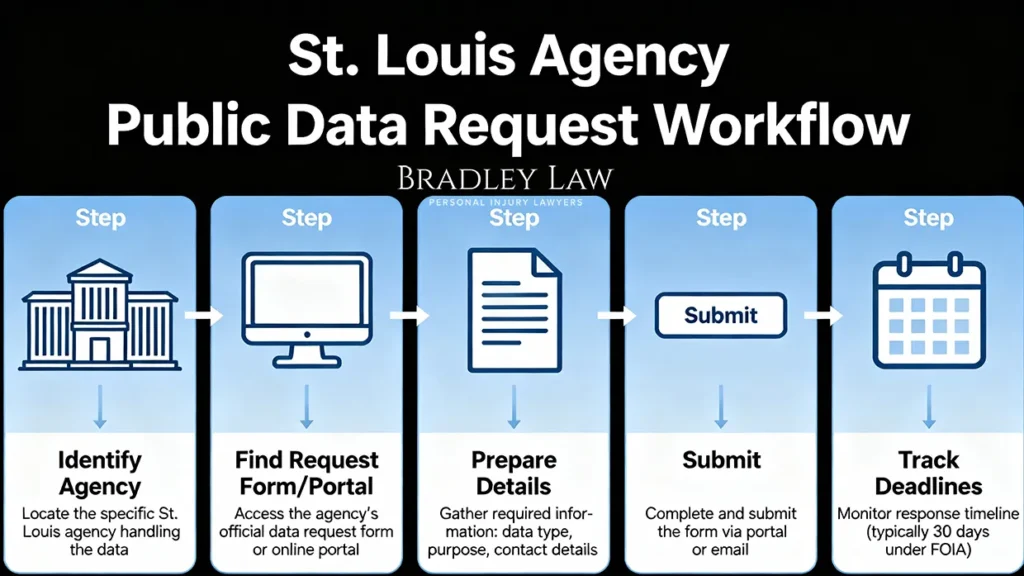
- SLMPD RTCC and police video: Submit a Missouri Sunshine Law request to SLMPD as soon as possible. Be specific about the date, time, location, and type of video you need (RTCC fixed camera, body-worn camera, in-car camera). The department must respond within three business days, though video related to an ongoing investigation may be temporarily exempt.
- Metro Transit video: Use Metro Transit’s Digital Video Recording Request for footage from Metro vehicles and facilities. Include the date, time, and station or location. Metro’s retention policies vary, so it’s best to request footage as quickly as possible.
- MoDOT traffic cameras: Highway cameras provide live feeds only, so there’s no footage you can request. You’ll need to pursue other sources, like business security cameras near highway exits or dashcams from other drivers.
- Private business cameras: Businesses aren’t subject to the Sunshine Law, so you’ll need them to voluntarily cooperate. Send a preservation letter immediately, describing the incident and politely requesting the preservation of video footage from the relevant date and time.
Preserving Evidence Quickly (Letters and Timelines)
Thirty days can go by fast, especially if you’re injured and dealing with the aftermath of an accident. But if your crash involved RTCC cameras, you must file a Sunshine Law request within the 30-day window, or you may lose the footage forever.
Missouri law includes exemptions that can delay or block access during active investigations. Filing early creates a paper trail showing you requested the video before it is deleted.
For business cameras, send preservation letters as soon as possible. Explain what happened and why the video is crucial evidence. Be polite but mention that you’re formally requesting preservation. If voluntary preservation requests don’t get results, consider speaking to an attorney. Litigation tools like subpoenas and court orders can preserve and retrieve the footage you need. A polite letter simply doesn’t carry the same legal weight as a subpoena.
Retention Guidelines at a Glance
| Source | Recorded? | Typical retention |
|---|---|---|
| MoDOT traffic cameras | Live view only; not recorded | Not applicable |
| SLMPD RTCC fixed cameras | Yes for department‑owned cameras; federated third‑party live feeds viewed but not recorded by SLMPD | 30 days unless tied to a case |
| City LPR (license plate readers) | Yes | 90 days |
| SLMPD body‑worn/in‑car video | Yes; retention by classification | Per MO Police Records Retention Schedule |
| Metro Transit vehicles/facilities | Yes | Request via Metro; retention varies by MTPD policy |
Proof Checklist: Sources to Pursue in St. Louis
Here’s a rundown of the video evidence you can start to gather immediately after your accident in St. Louis:
- SLMPD RTCC cameras where the accident occurred
- SLMPD body-worn and in-car camera footage from responding officers
- Business security cameras at nearby stores and office buildings
- Metro Transit cameras (if the crash happened near a station or involved a Metro vehicle)
- Personal dashcam or phone video from witnesses
- EDR data from all vehicles involved in the collision
Same-Day Checklist:
- File RTCC video request with SLMPD
- Submit Metro Transit video request if applicable
- Send preservation letters to nearby businesses
- Document EDR preservation hold for all vehicles
- Photograph camera locations in the area
Preservation Letter Template
Sending preservation letters to businesses and property owners as soon as possible is crucial. You can use this simple template to formally request that they save the relevant footage. Download the video preservation letter template.
Speak With An Attorney About Your Case
Practical Challenges and How to Overcome Them
Short video retention windows can be tricky when you want to preserve critical evidence. Thirty days for RTCC footage means you can’t wait, as the clock starts ticking the moment the crash happens.
While city intersections may have businesses with security camera coverage, highway crashes often lack this, meaning there may be no video recordings of your accident. And MoDOT’s non-recorded feeds can be frustrating for people who assume every traffic camera must be recording traffic.
Overcome these challenges by filing your Sunshine Law request and sending business preservation letters within 48 hours of your crash, even if you’re still recovering. And remember, video evidence is just one part of your accident puzzle. There is other evidence you can collect, such as witness statements and other drivers’ dashcam footage, that can prove your case.
The “Active Investigation” Challenge
Privacy exemptions during active investigations may mean that you temporarily can’t access police video footage, especially if your crash is being investigated as a potential crime, such as a DWI, hit and run, or vehicular assault. Missouri law under Mo. Rev. Stat. § 610.100 allows law enforcement to withhold mobile video recordings until investigations conclude.
While this can delay your claim, the exemption isn’t permanent. Filing your request early means your request is lodged, and once the investigation concludes, the agency must re-evaluate your request under the Sunshine Law.
Evidence You Should Still Collect When Video Is Missing
Even if there is no video available for your accident claim, you can still build a strong case and prove fault with other relevant evidence. Photograph all vehicle damage from multiple angles and capture the crash scene showing skid marks, traffic signals, and road conditions. Collect witness contact information while they’re still at the scene.
Request the police accident report as soon as it’s available. And make sure you preserve your car’s EDR data before you’re having it repaired (extracting it later can be difficult or impossible). Document your injuries with medical records and a daily pain journal. Medical evidence is essential for supporting your compensation claim and shows the real impact of an accident on your life.
When to Get a Lawyer Involved
Legal representation can be essential for getting what you deserve. Hire an attorney immediately if your crash involves any of the following:
- Serious injuries
- Disputed fault
- Missing evidence
- Insurance claim denial or delay
An attorney can help you file effective preservation demands and submit proper Sunshine Law requests. They can also use the legal process to get the video footage you need to prove your case.
Most personal injury attorneys work on contingency, which means you don’t pay any attorney’s fees unless you recover compensation. The first case review is usually free, and your attorney can start preserving evidence right away, giving you the best chance of recovering what you deserve.
References and Request Links
Looking for further information on video retention and public record requests? Here are some useful agencies and resources:
- Missouri Attorney General’s office for Sunshine Law information and guidance
- St. Louis Metropolitan Police Department for RTCC policies and video request procedures
- Missouri Department of Transportation for traffic camera operations and policies
- Bi-State Development and Metro Transit Police Department for Metro Transit video request procedures
- Federal EDR rules: 49 CFR Part 563
- Missouri Secretary of State’s office for law enforcement records retention schedules governing police video retention
FAQs
Can I request video from red light cameras in St. Louis?
St. Louis discontinued its red-light camera program years ago, so there are no active cameras now. If your crash happened at an intersection, look for RTCC fixed cameras and business security cameras instead.
Do I need a lawyer to file a Sunshine Law request?
No, you don’t need an attorney, as anyone can file a Sunshine Law request directly to a public agency. But if the agency denies your request or invokes exemptions, hiring an attorney can be critical, as they can challenge that response and use legal tools to get the evidence you need.
How much does it cost to get video footage from SLMPD or Metro?
Public agencies can charge reasonable fees for copying and producing records, including the cost of staff time to locate and redact video. While simple requests might be free or cost a few dollars, complex requests involving hours of footage can cost more. If the request is going to cost more than a certain amount, the agency has to give you a price estimate before moving forward.
What if SLMPD says there is no video for my crash location?
Unfortunately, not all locations in St. Louis are covered by RTCC cameras. But even if no city camera captured your crash, you could get footage from businesses, Metro Transit, or witness dashcams. You can also use EDR data from involved vehicles as evidence.
Bradley Law Can Help Secure Your Video Evidence
At Bradley Law, we’ve spent decades handling car crash cases across Missouri, and we’ve learned that the first 48 hours are critical for evidence collection. We can immediately file Sunshine Law requests, send preservation letters to businesses, and use subpoenas when needed to secure footage before it disappears forever.
We’ve recovered millions for crash victims by building strong cases with every piece of available evidence. And our team can handle the evidence preservation process while you focus on recovery. We work on contingency, so you pay nothing unless we win your case.
Contact us today for a free case review and discover how we can protect your evidence (and compensation claim) from day one.