

Ryan Bradley | December 29, 2025 | Car Accident \ Missouri Law

- The rear-end driver isn’t always at fault. Missouri law assumes the driver in the back caused the crash, but sudden stops without reason or unsafe lane changes can shift the blame to the driver in front.
- Chain reactions divide fault among multiple drivers. When three or more cars are involved in a crash, one driver rarely takes all the fault. Missouri courts look at each impact separately, and you could be both a victim and partly responsible.
- Evidence can help you challenge fault. Photos, dashcam video, vehicle data recorders, and witness statements can determine fault in rear-end accident cases.
Most drivers believe that getting hit from behind automatically means the other person pays, as that’s the rule everyone knows. Missouri law also typically assumes the driver in the back is at fault when they hit someone from behind. But that’s not always true.
According to the National Highway Traffic Safety Administration (NHTSA), rear-end collisions make up about 29 percent of all crashes nationwide. And when something happens that often, there are always plenty of exceptions to the rule. There are rear-end scenarios, where the driver in front can share the blame or even be completely at fault. Understanding these exceptions is crucial to protecting yourself after a rear-end collision.
In this guide, you’ll learn the most common myths about rear-end crashes in Missouri and how evidence can shift fault.
| Myth | Reality | Authority Regulations |
|---|---|---|
| A sudden stop makes the front driver at fault. | Missouri imposes a duty not to follow more closely than is reasonably safe, so liability typically remains with the rear driver unless evidence shows unusual or reckless conduct by the lead driver. | Missouri Revised Statutes §304.017 (Following Too Closely). |
| An unsafe cut‑in excuses the rear driver. | Abrupt lane changes can shift or share fault, but they do not automatically absolve tailgating or inattention; reconstruction weighs headway, signal use, and timing. | NHTSA 100‑Car Naturalistic Study (rear‑end conflict dynamics) and CrashStats portal. |
| Broken brake lights and true brake failure are the same defense. | Nonfunctioning brake lights and loss of braking power are distinct issues; lighting defects implicate notice/maintenance and perception–response, while verified mechanical failure may rebut negligence if maintenance was reasonable. | RSMo §304.017 (safe following duty) and NHTSA mechanical failure analyses. |
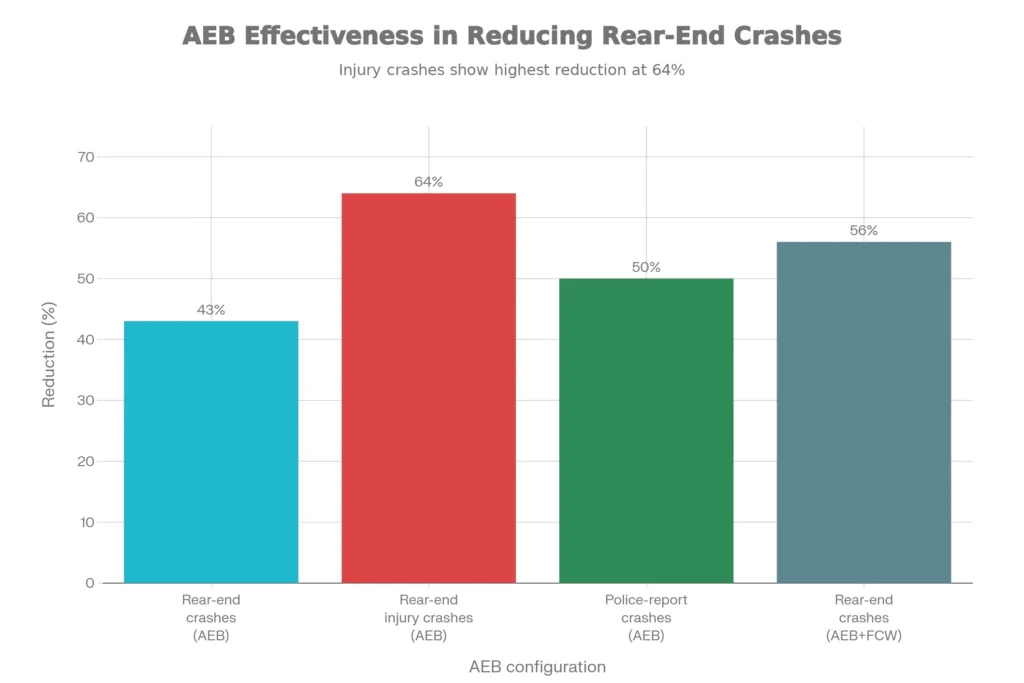
| AEB increases rear‑end crashes. | Research shows automatic emergency braking substantially reduces rear‑end crash and injury rates across vehicle types. | IIHS evaluations of rear autobrake effectiveness and updates on AEB performance. |
| In chain‑reactions, blame the last car. | Fault is apportioned by each vehicle’s causal contribution using sequence analysis, EDR data, and impact timing rather than a single‑driver rule. | NHTSA 100‑Car Study (near‑crash/sequence methods) and CrashStats portal. |
Why Myths Persist: Rear-End Crashes Are Common and Nuanced in Missouri
You hear the same certainties repeated at accident scenes, in insurance calls, and across kitchen tables throughout Missouri: “The person in the back is always at fault in a rear-end accident.” This idea sticks around because it’s true of most rear-end crashes. They are often caused by distraction or following too closely. So it’s natural to assume the rear driver carries all the blame, all the time.
But there are other cases: A driver who suddenly cuts in and slams the brakes isn’t the same as someone who is rear-ended at a red light. And a car with broken brake lights creates a hazard for those behind. Those details, if they are properly recorded in an accident, can shift fault to the driver in front. And Missouri courts recognize that the driver in the back isn’t always to blame.
Missouri’s Baseline Rule and Duty to Follow at a Safe Distance
Missouri has what lawyers call the “rear-end collision doctrine.” It means that the driver in the back is assumed to be at fault if you can show these three things:
- You had the right to be where you were on the road
- The other vehicle hit you from behind
- You weren’t driving carelessly or breaking traffic laws
Under Mo. Rev. Stat. § 304.017, following too closely in Missouri is a traffic violation. Drivers must leave enough space to stop safely behind the car ahead. That space depends on weather conditions, how fast you’re going, and how heavy the traffic is. The law simply assumes that if you rear-end someone, you didn’t leave enough space.
The Rear-End Presumption Isn’t the Final Word
Missouri uses a pure comparative fault system under Mo. Rev. Stat. § 537.765. This means all drivers in an accident can share responsibility, and you can recover car accident damages even if you’re up to 99% at fault. Your compensation is then reduced by your percentage of fault.
Myth 1: “Sudden stop means the front driver is at fault”
People often think that if they had to stop suddenly, the rear-end accident wasn’t their fault. But in sudden-stop rear-end cases, Missouri law doesn’t necessarily see it that way. Remember, the driver in the back must leave enough room to stop safely, even if traffic slows down without warning.
Sudden stops happen all the time. For example, a child runs into the street, or the car two vehicles ahead slams on the brakes. These situations are exactly why you need to leave adequate space between your car and the one in front of you.
When Do Sudden Stops Create Liability?
However, sudden stops can shift fault to the front driver when they’re unreasonable and without justification. Stopping dead in the middle of a highway with no hazard and no mechanical problem or other emergency is reckless. Brake-checking (slamming on your brakes deliberately because someone is tailgating you) can shift substantial fault to the driver of the front vehicle.
A driver who stops suddenly because they missed their turn isn’t making a justified stop. But a driver who stops suddenly because traffic ahead has halted abruptly for whatever reason is acting reasonably, even if it seems too sudden to the person behind them.
Myth 2: “Unsafe cut-ins excuse the rear driver”
Lane changes can shift fault to the front driver, but it depends on the circumstances. If someone merges into your lane and immediately slams on the brakes, they can be held liable. The question courts ask is simple: Did the merging driver give you enough time and space to react?
Missouri courts examine what happened right before the crash:
- How much space was there between the cars before the merge?
- Did the driver use their turn signal?
- Was the merging car going much slower than the traffic it cut into?
These details show whether the lane change was reasonable or whether it created a dangerous situation where a crash was inevitable.
But what if the driver merged into your lane and drove normally for several seconds before braking? This means you had time to adjust and couldn’t typically claim that the lane change caused the crash. You could have backed off and created space. But if the brake lights come on within a second or two of the merge, you likely had no chance to avoid hitting them.
Dashcam footage can be critical evidence in these scenarios because it shows exactly how much time passed between the merge and the braking. And witnesses who saw the collision can describe how much space was available and whether the merge was smooth or abrupt.
Myth 3: “Brake issues and broken lights are the same defense”
There’s a difference between brake lights that don’t work and brakes that fail. Faulty brake lights affect what the rear driver could see. Malfunctioning brakes affect what the rear driver could do to avoid a crash.
Brake Light Defects Can Make the Front Driver Liable
When brake lights don’t work, the driver behind you loses their main warning that you’re slowing down or stopping. Brake lights exist for exactly this reason: to tell other drivers you’re braking and give them time to react.
Broken brake lights rob the rear driver of reaction time, especially in fast or heavy traffic. If you’re driving with broken brake lights, you’re creating a hazard on the road. This means you may be partially or entirely at fault for an accident, depending on how much the defect contributed to it. But to prove that the front driver is at fault, you need documentation:
- Photos of the brake light condition immediately after the crash
- Witness statements from other drivers who noticed the non-functioning lights
- Maintenance records showing the front driver knew about the problem but failed to fix it
These three pieces of evidence can work together to show that the defect existed at impact and that the front driver bears at least some responsibility for the accident.
Brake Failure Isn’t a Free Pass for Rear Drivers
Brake failure means the brakes themselves stopped working. Maybe the brake pads wore through, a brake line broke, or the hydraulic system failed. Under Mo. Rev. Stat. § 307.170, brakes must be in good working order. Missouri law typically assumes brake failures happen because the vehicle owner didn’t maintain their car properly.
If you claim your brakes failed in an accident, you need to prove it was sudden and impossible to predict. A brake line that snaps without warning might count, especially if your service records show regular inspections and no prior brake issues. But brake pads that have ground down over months will likely count as neglected maintenance.
Myth 4: “Chain-reactions are simple—blame the last car”
When three or more cars crash in sequence, you can’t just point at the last driver to carry all the fault. Missouri’s comparative fault system means everyone involved in a crash could be responsible to varying degrees.
The driver who causes the first collision usually takes the biggest share of fault, but that doesn’t mean they’re automatically 100% responsible. Other drivers can share the blame if their actions contributed to what happened. Here’s an example of how this can play out:
In a five-car pileup, Driver C rear-ends Driver D, pushing Driver D forward into Driver E. If Driver D was following too closely, they might share some of the blame for not leaving enough space to stop safely. In that case, Driver C could be assigned 70% of the fault for triggering the chain reaction accident, while Driver D might carry 30% of the responsibility for contributing to the second impact.
But how do investigators determine fault in such complex crashes?
- Physical evidence. To determine fault, accident reconstruction experts follow standards established by the Accreditation Commission for Traffic Accident Reconstruction (ACTAR) and the NHTSA. They look at damage patterns and other physical evidence to piece together how each vehicle moved during and after the collision.
- Vehicle data. Event data recorders (EDRs) record your speed and when you hit the brakes. Investigators can download and look at this data to figure out the timing and force of impacts.
- Witness testimony can be crucial in determining who was responsible, as they may have watched the entire crash, while drivers only know what’s happening right around them.
Tech Reality Check: AEB Reduces Rear-End Crashes and Injuries
Automatic emergency braking (AEB) is perhaps one of the biggest safety breakthroughs for preventing rear-end crashes since anti-lock brakes. According to the Insurance Institute for Highway Safety (IIHS) research, forward collision warning, together with AEB, can cut rear-end crashes and injuries by half.
Here’s how AEB works: sensors on your car (radar, cameras, or lidar) monitor the distance between you and the car ahead, and when a crash is about to happen, the system will alert you. If you don’t hit the brakes, the car will do it automatically, potentially preventing a rear-end crash.
But AEB isn’t perfect. The systems don’t work as well in bad weather, such as wet or snowy roads. The technology helps prevent crashes, but it doesn’t replace drivers paying attention and keeping a safe following distance.
Evidence That Moves the Needle in Exceptions
If you want to challenge fault in a rear-end crash, you require strong evidence, and it needs to be collected quickly. What you document in the first hour after the collision often decides whether you can prove an exception. Here’s the most critical evidence:
- Brake light and bulb condition before vehicles are towed or repaired
- Dashcam footage from your vehicle and nearby cars
- Event data recorder (EDR) downloads
- Witness statements about timing, spacing, and signal use
- Maintenance records showing brake light defects or mechanical issues
Unfortunately, time destroys evidence, and you must gather proof before vehicles get repaired, memories fade, and EDR or dashcam data is overwritten. According to the NHTSA, EDRs in particular are invaluable tools for crash reconstruction because they can capture critical data like pre-crash speed and braking activity.
What Missouri Drivers Should Do After a Rear-End Crash
What you do in the minutes right after a crash can make or break your entire case. Here are your next best steps:
- Call 911. Call the police to the scene. Even in minor crashes, a police report can be critical for an insurance or legal claim. Ensure that everyone in all vehicles is safe before documenting anything. If anyone is injured, request medical assistance.
- Document the crash scene and lamp status. Take close-up photos of brake lights and taillights from multiple angles, both off and with someone pressing the brake pedal. Photograph where each vehicle stopped relative to lane lines, road edges, and nearby signs or mile markers. Make sure to capture the entire accident scene.
- Record driver statements. Write down what the other drivers are saying at the scene. Statements about not seeing brake lights or not having time to stop can be essential evidence.
- Preserve time-sensitive evidence. Ask witnesses for contact information and statements, and write down everything you remember about the moments before impact. Preserve dashcam footage and download your EDR data before it is overwritten.
Your Rear-End Accident Evidence Checklist
Here’s a condensed checklist to ensure you’re not missing anything vital:
☐ Call 911
☐ Photograph lamp status
☐ Document vehicle positions
☐ Capture spacing markers
☐ Get immediate statements from other drivers
☐ Collect witness information (names, phone numbers, and statements)
☐ Save dashcam evidence
☐ Seek medical evaluation
For comprehensive guidance on post-crash steps, see our complete guide on what to do immediately after a car accident. This post offers an outline of common rear-end accident injuries that occur.
FAQs
Can I be at fault if I’m hit from behind?
Yes, but it’s less common. Missouri law presumes the rear driver was negligent, but there are some exceptions to the rule. For example, if you stopped suddenly without justification, had non-functioning brake lights, or made an unsafe lane change immediately before being hit, you may be at fault.
How long do I have to file a claim after a rear-end collision in Missouri?
Missouri’s statute of limitations, under Mo. Rev. Stat. § 516.120, gives you five years from the date of the accident to file a personal injury lawsuit. Don’t wait too long to speak to an attorney, as evidence can disappear and witness memories fade.
What if the other driver claims I brake-checked them?
Brake-checking allegations require proof. The other driver needs to show you slammed on the brakes without legitimate justification. If you didn’t brake-check another driver, your EDR data should show that you engaged in normal braking.
Will my insurance rates go up even if the rear-end crash wasn’t my fault?
Your insurer shouldn’t raise rates after a not-at-fault accident. But the reality is more complicated. If the crash involved any comparative fault on your part, insurers may treat it as an at-fault accident and bump up your rates.
Rear-Ended and Accused? Bradley Law Can Fight Back
Rear-end crashes look simple until you’re fighting with an insurance company that won’t accept that you’re not to blame. The adjuster insists you were at fault because you got hit from behind. And the other driver’s attorney argues you stopped without reason, or your brake lights weren’t working.
But you don’t have to fight insurers and lawyers alone. Bradley Law knows what evidence convinces insurance adjusters, what arguments sway juries, and when to take a case to trial.
The time to file a lawsuit in Missouri is limited, so don’t wait and contact us today for a free case review. We’ll review your case and your best path forward.