

Ryan Bradley | November 23, 2025 | Car Accident \ Missouri Law
Key Takeaways:
- The Missouri Uniform Crash Report isn’t the final word on fault. Accident reports are based on preliminary observations and aren’t set in stone. They may also include mistakes or may have left out crucial details.
- Contributing circumstances codes tell you what the officer thinks caused the crash. Understanding accident report codes helps you challenge unfair blame and identify what evidence you need to prove your version of events.
- You can contest mistakes and submit supplemental statements. If an accident report misrepresents what happened or if there are errors, you can correct the record and protect your claim.
After a Missouri car accident, the police report can be a crucial document in your insurance claim or legal case. The codes and diagrams inside can determine who gets blamed and how much you recover. While insurance adjusters use the report to decide fault, attorneys use it to build your case.
But the Missouri Uniform Crash Report (MUCR) isn’t a neutral record of facts. It’s an officer’s interpretation of what happened in your accident. And here’s the problem: officers often arrive to chaos and only write the report hours later back at their desk.
An officer may check codes in error in the heat of the moment, and diagrams may oversimplify what happened. Or the officer’s narrative leans heavily on one driver’s version of the crash while ignoring other statements and physical evidence.
Our guide breaks down Missouri’s fault determination process using the MUCR, what the codes and diagrams in your report mean, and how you can challenge errors that could hurt your claim.
Why the Crash Report Matters for Fault and Insurance
Insurance adjusters treat the Missouri Uniform Crash Report like gospel, even though it’s not legally binding in court. They may use the report to make quick fault determinations. And if it codes you as the primary cause of the crash, get ready for a denial letter or a lowball offer.
The accident report is vital because it’s fast and carries the authority of law enforcement. Insurers know most people won’t know that they can challenge it. And attorneys use the MUCR to build your case. It tells us what evidence we need to collect and where the insurance company will likely attack your claim.
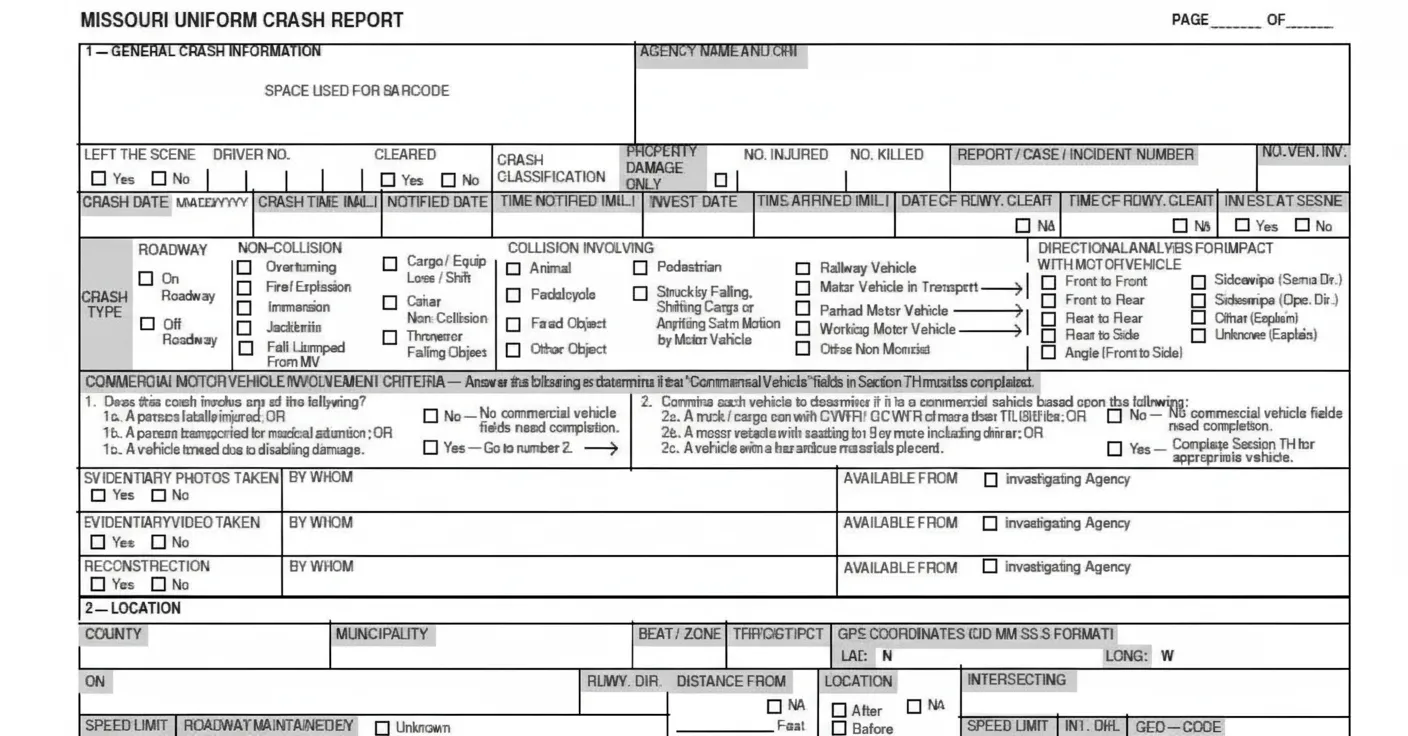
What the Missouri Uniform Crash Report Includes
The MUCR is a standardized form used statewide by local police and the Missouri State Highway Patrol. Every crash report follows the same structure, making it easier to compare data across jurisdictions. The key sections of the report include:
- Basic information. Date, time, location, weather, road conditions, and any other facts of the accident scene.
- Involved party details. Complete driver and vehicle information for everyone involved in the crash.
- Contributing factors. Numeric codes describing what the officer believes caused the crash, whether it was speeding or something else.
- Crash diagram. Bird’s-eye sketch showing the roadway layout with vehicle positions, impact points, skid marks, and traffic controls.
- Officer’s description. Written narrative of what happened based on witness statements and the officer’s observations.
- Details of citations issued. Traffic tickets given at the scene with violations the officer believed occurred.
- Injury and damage assessments. Severity of injuries and estimated property damage.
“Probable Contributing Circumstances” Codes: What They Mean
Missouri crash reports use standardized contributing circumstances codes to classify what (or who) caused the accident. Officers select codes based on observations, driver statements, and physical evidence. Understanding these codes helps you spot errors.
Here are some commonly used accident report codes:
| Code | Category | Description |
|---|---|---|
| 01 | Driver Action | Exceeded posted speed limit |
| 02 | Driver Action | Driving too fast for conditions (unsafe even if under the limit) |
| 12 | Driver Action | Failure to yield right-of-way |
| 13 | Driver Action | Following too closely (standard in rear-end collisions) |
| 14 | Driver Action | Improper lane change |
| 18 | Driver Action | Inattention/distraction (includes eating, passengers, etc.) |
| 19 | Driver Action | Cell phone use |
| 50 | Impairment | Under the influence of alcohol |
| 51 | Impairment | Under the influence of drugs (including legal and illegal substances) |
| 70 | Environmental Factor | Wet roadway |
| 71 | Environmental Factor | Icy roadway |
| 73 | Environmental Factor | Fog, smoke, or dust |
| 76 | Environmental Factor | Roadway defect (potholes, debris, or construction) |
| 80 | Vehicle Condition | Brakes defective |
| 81 | Vehicle Condition | Tires defective |
Officers are instructed to select only codes that actually contributed to the crash. But in practice, they may check multiple codes to cover themselves, which can create a misleading picture. For example, if the report codes you for “failure to yield” when you had a green light, that’s a contestable error.
Remember, these codes reflect the officer’s interpretation of contributing factors and are not a legal fault determination. If you disagree with a code, you may submit a supplemental statement or challenge it with supporting evidence.
In cases where vehicle condition codes (such as defective brakes or tires) appear in reports and defects persist beyond the crash, owners in other states may consult a vehicle warranty lawyer in Texas for guidance on warranty claims or manufacturer accountability.
Reading the Collision Diagram Like an Investigator
The crash diagram on Missouri police reports is supposed to present a scaled and accurate representation of the crash scene. However, in reality, it may just be a hasty sketch drawn hours later when the officer is back at the station. And insurance adjusters may treat the diagram as if it were a precise drawing of the crash, especially if it allows them to deny or reduce a payout.
What the Diagram Should Show
The diagram should clearly show the roadway layout with its lanes and shoulders. It should also mark where vehicles travelled and where they hit and stopped. Impact points are usually marked with an “x” or a star. Pre-impact paths may be shown as dotted lines or arrows showing how each vehicle moved before the collision. These paths help to show who had the right-of-way and whether someone swerved or braked.
Traffic controls like stop signs or signals should also be presented in the diagram. So should any skid marks or debris.
Accident scenes are often stressful for law enforcement, and an officer hardly gets the time to sit down, concentrate, and draw an accurate diagram at the scene. This can lead to errors, such as misplacing a stop sign or drawing vehicles in the wrong lanes. For example, if the diagram shows you crossing the center line, but your vehicle damage is on the passenger side, the diagram can’t be right.
Challenging a flawed diagram can be tricky and requires gathering evidence, such as photos showing the actual scene layout and expert analysis of vehicle damage patterns.
The Officer’s Narrative and Statements: Where Nuance Lives
The narrative section is where the officer explains what they believe happened in plain language. A good account of the accident weaves together the physical evidence with driver and witness statements. A bad narrative cherry-picks one driver’s story or jumps to unsupported conclusions. Here’s what to look for when analyzing an officer’s account of the crash:
- Whose statements are included? Did the officer talk to all drivers, passengers, and independent witnesses? Or did he only note one side of the story?
- Physical evidence description. Do skid marks, damage, and debris match what the diagram shows and the officer’s narrative?
- Fault conclusions. Some officers explicitly state who caused the crash; others imply it through their choice of words.
- Mismatches with evidence. If the narrative says you ran a red light but damage patterns contradict that, it’s worth challenging the report.
The officer’s account will also reveal what evidence wasn’t collected. If there’s no mention of surveillance cameras or cell phone records, your attorney will know what they need to gather independently.
The Legal Backdrop: Reporting Duties and Comparative Fault
Missouri law, under Mo. Rev. Stat. § 303.040, requires crash reports if the accident caused injury, death, or more than $500 in property damage. Reports must be submitted to the Missouri Department of Revenue within 30 days. If officers didn’t attend the scene of your crash, you’re responsible for filing your own report form.
Missouri’s comparative fault rule (Mo. Rev. Stat. § 537.765) means the crash report doesn’t have to show you’re completely blameless for the accident in order to recover compensation. If the report assigns you partial fault, your compensation just gets reduced by your percentage of fault. Challenging exaggerated fault assessments is vital because every percentage point your fault assignment is reduced means more money in your pocket.
Admissibility Reality: How Police Reports Are Used (and Not Used)
The officer’s opinion about fault is typically classed as inadmissible evidence (“hearsay”) at trial. Missouri courts usually exclude the “conclusions” portion because the officer wasn’t an eyewitness to the crash. But factual observations, such as the vehicle damage and citations, can come into evidence through officer testimony.
Although an officer’s narrative may be excluded from a trial, insurance companies typically use it to make initial fault determinations and settlement offers. And the report drives your case from the start by telling you what evidence matters and which liability arguments will work. Your negotiating power also flows from what’s included in the report, such as citations of other drivers. And correcting mistakes early can protect your negotiating position and compensation.
Speak With An Attorney About Your Case
What Crash Report Details to Challenge and How
If your crash report contains errors that could hurt your claim, you can (and should) request corrections or submit supplemental statements. Here’s what’s worth challenging:
- Incorrect contributing circumstances codes, such as failure to yield when you had the right-of-way.
- Diagram errors, including wrong lanes and missing traffic controls.
- Narrative inaccuracies, such as statements attributed to you that you didn’t make.
- Missing witness information, such as statements eyewitnesses made at the scene that don’t appear in the report.
- Citation errors, like tickets issued incorrectly or citations that don’t match what happened.
How Do You Challenge Inaccuracies in a Missouri Car Accident Report?
Contact the investigating agency (typically the local police department or the Missouri State Highway Patrol) in writing as soon as possible. Explain the specific errors and provide supporting evidence, such as photos and witness statements. And make sure to request an amendment or supplemental report.
Some agencies will amend the report, and others will attach your statement to the file. Either way, you’re protecting your claim by getting your version on record. To give yourself the best chance of recovering what you deserve with a car accident claim, act quickly and challenge any reporting errors as soon as you spot them.
Step-by-Step: Auditing Your MUCR
When you get your crash report, audit every section to catch errors before they become accepted as “facts.” Here’s your quick reference audit checklist:
- Party information. Check that every party is listed and verify names, addresses, insurance information, and vehicle details.
- Crash details. Make sure all the basic crash facts are correct (date, time, location, weather, road conditions).
- Contributing codes. Look up and identify what the codes assigned to you mean, and whether they’re accurate.
- Collision diagram. Does the diagram look correct? Compare it to your photos from the accident scene and determine whether anything is inaccurate or missing. Compare impact points against actual damage.
- Officer narrative. Review which statements are included. Is the narrative complete? Also, check whether the officer’s account matches physical evidence, and if fault conclusions are supported.
- Citations. Verify what tickets were issued and to whom. Do they match what happened and the relevant codes?
- Injury. Ensure injuries are noted and the severity is accurate. For example, the report should not state “no injury” if you were treated at the scene or went to the ER.
And, again, if you find any errors, no matter how insignificant you may think they are, make sure to document them immediately and let your attorney know or contact the relevant law enforcement agency for corrections.
Getting and Preserving the Report
Missouri police accident reports are usually available through the investigating agency within 7-10 days for a small fee. Request MSHP crash reports online through the Missouri State Highway Patrol’s portal, or at the agency’s records office:
State Highway Patrol Traffic Records Division
P.O. Box 568
Jefferson City, MO 65102
Phone: (573) 526-6113
St. Louis Area Requests
St. Louis City and St. Louis County use the same Missouri Uniform Crash Report with the same codes and diagrams as the rest of the state. The main differences are in where you request your copy and processing timelines:
- St. Louis Metropolitan Police Department. Request reports through the Records Service Center or check the Daily Accident Report list online for your crash.
- St. Louis County Police. Contact the Bureau of Central Police Records for reports with posted timelines and fees.
St. Louis-area agencies use regional electronic systems REJIS (Regional Justice Information Service) and LETS (Law Enforcement Traffic System) to submit crash reports to Missouri’s Statewide Traffic Accident Records System (STARS), but the information captured still maps to the standard MUCR form and codes.
To obtain the police report, you’ll need to provide information about the crash date, location, and either a driver’s name or case number. Save the original and make copies. If you submit a supplemental statement or the agency amends the report, make sure you request the updated copy. Read our STL police crash report guide.
When to Bring in an Attorney or Reconstruction Expert
Some crashes need professional help to prove fault. Work with an attorney or reconstruction expert if:
- You have severe injuries or have suffered a permanent disability
- The crash involved multiple vehicles and complex liability issues
- You were involved in a crash with a commercial vehicle
- Someone died in the accident
- An insurance company has already denied or reduced your claim
Accident reconstruction experts can examine vehicle damage and other evidence, such as surveillance footage, and determine what happened. They use sophisticated programs to calculate speeds and prove impact angles. In serious injury cases, having both an attorney and an industry expert in your corner protects you from predatory insurers pushing you into lowball settlements.
Bottom Line: Build Your Evidence Beyond the Report
The Missouri Uniform Crash Report is a starting point that can help you build a strong case. Use it as a roadmap to identify the evidence you need, like photos showing the accident scene layout, scene measurements that can prove fault, and witness statements contradicting an officer’s account. You could also use a car’s EDR (Event Data Recorder) data proving the other driver was speeding.
Fortunately, Missouri’s comparative negligence rule means you don’t have to prove the other driver was 100% at fault. You just need to make sure the percentage of fault assigned to you is fair and not based on an insurance company trying to get out of paying you what you deserve. If the report supports your case, use it. If it doesn’t, make sure you challenge the errors early on and build a competing narrative backed by facts.
Working with an attorney can be crucial, especially if an accident report paints an unfair or incorrect picture and you’re severely injured.
FAQs
How do I get a copy of my crash report in Missouri?
Request your report online through the Missouri State Highway Patrol’s portal or contact the local police department that investigated.
What if the officer didn’t file a report at all?
If police didn’t respond, Missouri law requires you to file a crash report with the Department of Revenue within 30 days if the crash caused injury, death, or more than $500 in damage.
How much does it cost to challenge a crash report?
Nothing. There’s typically no fee to submit a supplemental statement or request corrections. If you hire an attorney or reconstruction expert, those costs vary but are often recovered from your settlement if you win your injury case.
Will correcting my crash report guarantee a better settlement?
Not automatically, but it can help by removing any ammunition the insurance company may be using against you. A corrected report can shift negotiations in your favor, especially if the mistake or omission was crucial for determining fault.
Contact a Missouri Car Accident Attorney
Dealing with crash reports and challenging errors is the last thing you need when you’re trying to recover and heal. But you don’t have to go it alone. At Bradley Law, we’ve challenged flawed Missouri Uniform Crash Reports and recovered full and fair compensation for clients even when the initial police report was unfavorable. We can focus on the details of your claim, including accident reports, while you can concentrate on your health.
If your crash report is wrong or if the insurance company is using the MUCR to deny or lowball your claim, don’t wait to get help. Get started today and contact us for a free consultation so we can assess your case and determine the best options for you.